- Category
- Culture and reading
- Area
- Fort and Kala Ghoda
- Best setting
- A long flight or a monsoon afternoon
- City name
- Bombay and Mumbai, both used
Why read before you arrive
Mumbai rewards a reader. The city's literature is unusually rich in place: a book can put you on a Colaba pavement, inside a mill compound or on a suburban train before you have set foot in any of them. Novels and memoirs also explain the things a guidebook states flatly, such as why the city was renamed, why the railways are so crowded, and why so many people arrived here from elsewhere.
Reading also teaches you what to look at. A traveller who has read a novel set around the Fort will notice the balconies, the iron railings, the old newspaper offices and the Irani café tables. None of this is a substitute for walking. It is preparation, and it makes the walking better. The books below are a starting shelf, mixed between fiction and memoir.
- Read one novel set in the neighbourhood you plan to walk first.
- Keep a memoir for the flight and a novel for the evenings.
- Note that some titles use the old name, Bombay, throughout.
Novels of the old city
The classic starting point is Rohinton Mistry's "A Fine Balance", a long novel of four lives thrown together during the Emergency of the 1970s. Its city is recognisable: crowded rooms, tailors' workshops, the railway, and a coastline that keeps appearing at the edge of the story. "Such a Long Journey", by the same author, is shorter and set in a Parsi household in a Bombay building, with neighbours, a bank, and the politics of 1971 running underneath.
For the Fort and Kala Ghoda in particular, the old commercial streets, the newspaper offices and the rooms above the shops appear again and again in Indian writing. Mistry's Parsi Bombay is one thread. Another is the world of the mills and the labouring city in the novels of the 1970s and 1980s. Read these for texture rather than for addresses. The streets have changed and many of the buildings have not.
Memoirs and the city's voice
Memoir does a different job. It gives a single voice, a family and a set of habits, which is often closer to how a visitor experiences Mumbai. Writing about food, about a building, about a school or a train journey tends to stay in the memory longer than plot. Look for memoirs by writers who grew up in the city's older neighbourhoods, and for essay collections by journalists who spent years on its streets.
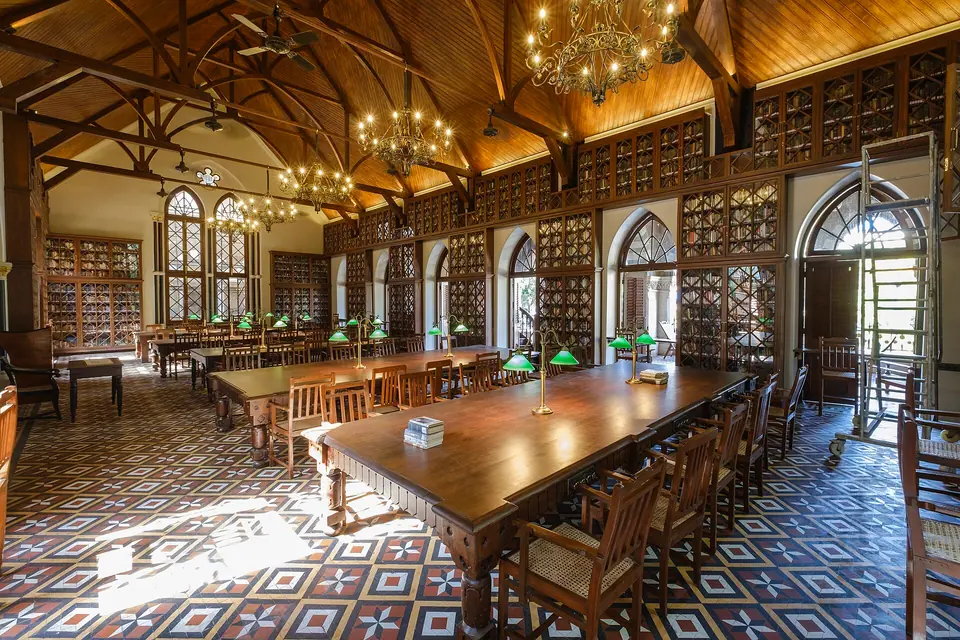
The city's literary life is centred on the Fort and Kala Ghoda. The Asiatic Society Town Hall at Horniman Circle, completed in 1833, is the old library and research institution at the heart of it. The Jehangir Art Gallery, opened in 1952 at Kala Ghoda, holds exhibitions rather than books, but the surrounding lanes concentrate galleries, colleges and old bookshops. The Kala Ghoda Arts Festival, held every February since 1999, adds readings and talks.
- The Asiatic Society Town Hall at Horniman Circle is the city's oldest learned institution.
- Kala Ghoda's February arts festival includes literary sessions and talks.
- Second-hand bookstalls appear around the Fort's pavements and near the colleges.
- Mumbai's newspapers have long employed writers who also publish books.
Poetry and the sea
Mumbai's poetry is often about water, arrival and the shoreline. Much of it is written in Marathi, and translations are worth seeking out. The Marathi literary tradition is the city's own, not an import, and it carries the vocabulary of the neighbourhoods, the markets and the monsoon. The annual literary festivals and the university's language departments have made more of it available in English than was the case a generation ago.
Reading a poem before a walk along the sea wall changes the walk. Marine Drive, the Backbay Reclamation and the Art Deco curve are protected as part of the UNESCO World Heritage Site listed in 2018, and the sea is the reason the curve exists at all. Take a short collection to the sea wall in the evening. It weighs almost nothing and takes less time than a novel.
Books set in the neighbourhoods
Fiction follows the city outward. Bandra, with its churches, its Catholic families and its lanes running down to the fort at Land's End, has produced a body of writing about a somewhat separate place, once a suburb and now central to the city's life. Mount Mary Basilica and the Bandra Fair, held in the week after 8 September, appear in it often. The East Indian villages of the north have their own memoir and recipe traditions, built around bottle masala and village feast days.
Byculla and the old mills give another set of stories, less sentimental and more historical. The Dr Bhau Daji Lad Museum, the city's oldest, opened in its present building in 1872 and sits in the grounds of Rani Baug. Novels about the mills and the docks tend to be about work, unions and migration, and they explain the shape of the city's centre better than a map does. Khotachiwadi in Girgaon, a lane of wooden houses settled by East Indian families in the 19th century, has its own small literature of memory.
For first-time visitors the practical advice is to pick two books, not ten. One novel set in the Fort or the old city, one memoir from a neighbourhood you intend to visit. Read the novel first. It will give the streets a set of characters, and the characters will give the walk a reason.
- Shop for second-hand titles in the Fort's pavement stalls and near the colleges.
- The Asiatic Society Town Hall and the Kala Ghoda galleries sit a few minutes apart.
Reading in the city
There are good places to read in Mumbai. The gardens around the museums, the sea wall at Marine Drive in the early morning, and the steps of the Banganga Tank at Walkeshwar, where a classical music festival is held in January, all work. The tank's present structure was rebuilt in 1715 and the site is quiet on weekday mornings. Sit at a distance from the water and from anyone praying, and put the book down when the place is more interesting.
Monsoon afternoons are the best reading weather in the city, and the season runs roughly from early June to late September, though the dates vary each year. Libraries and reading rooms in the Fort welcome visitors, though membership rules differ and it is worth checking ahead. Khotachiwadi is a residential lane, so walk through it with a book in hand rather than settling down to read in it.
Bookshops come and go, and the second-hand trade moves between pavements and stalls, so check before you set out. What does not change is the material itself: the novels and memoirs of Mumbai remain the cheapest, lightest and most useful guide to the city's manners. Carry one. Read it on the plane, and again at the end of the day, when the streets you have walked are still fresh.
Editorial review: 16 November 2026 · imptmumbai.in, written with AI assistance (see the editorial policy).