- What it is
- A half glass of milky tea
- How to order
- Ask for one cutting chai
- Where to try
- Railway stalls and street corners
- Area to try
- CSMT and Crawford Market
What a cutting chai is
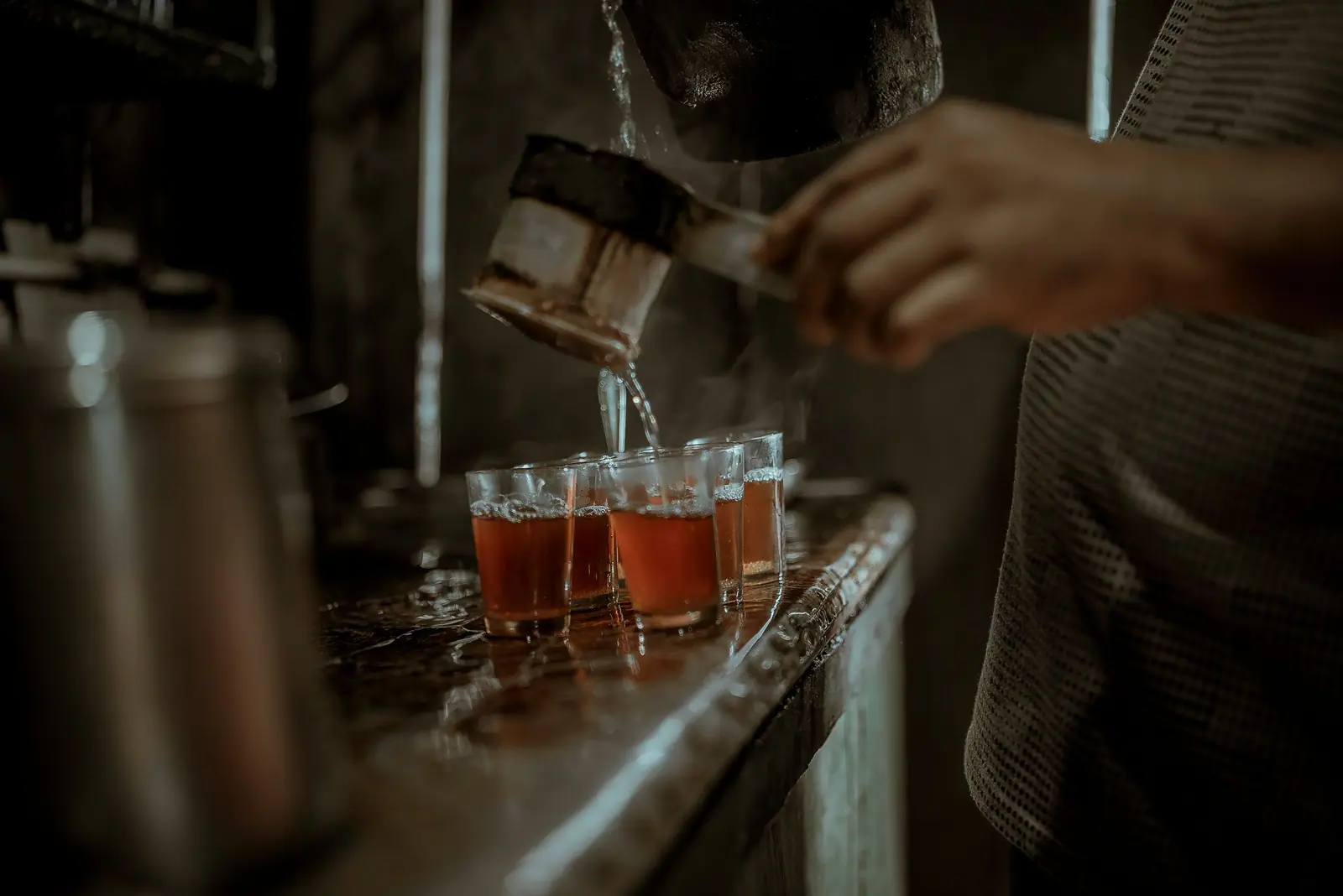
A cutting chai is a small glass of tea, filled roughly halfway. The tea inside is not weak: it is boiled strong with milk and sugar until it turns a pale brown, then poured hot from a height. The glass is small, the tea is concentrated, and the drink is finished in a few minutes. It is the standard order at the stalls that line station approaches, market lanes and busy footpaths.
The word does the explaining. A cutting is a half, a portion cut down from a full glass, and the phrase has passed into ordinary Mumbai speech. Order a full glass and you get twice the volume; order a cutting and you get the same strength in a smaller measure. For most drinkers the cutting is the sensible size: enough to wake you up, small enough to order again through the day, and quick enough to finish while standing.
Where the half glass comes from
The usual explanation is arithmetic. Tea stalls served crowds who arrived in bursts, off trains, out of mills and markets, all at once. Pouring half glasses stretched a pot further and got everyone served before the next rush. A smaller glass also cooled faster, which mattered when the tea was boiled and poured scalding. The habit stuck because it suited both sides: quicker service at the counter, a hotter drink for the customer.
The railway gave the cutting its widest audience. The suburban lines empty and refill stations all day, and the stalls at station approaches are often the first and last stop of a journey. Vendors work fast, moving along a tray of small glasses rather than filling one large cup. The glass itself, thick and sturdy, is part of the picture: held in one hand, rinsed and returned, refilled for the next customer, and often collected by the stall later.
Other tea-drinking cities have their own measures, and the small glass is not unique to Mumbai. What is particular here is the way the cutting fits the street: the stall, the crowd, the short stop. The glass is small enough to hold while standing, and the tea is strong enough that half is plenty. Ask for a cutting anywhere in the city and the order is understood without explanation. It is ordered by name, not by size, which tells you how settled the habit is.
Ordering and drinking it
Ask for one cutting chai and the vendor will reach for a small glass. Say extra sugar if a sweeter glass is wanted; say less sugar, or no sugar, and it will be made that way. Kadak means strong, extra boiled, and is worth knowing if the standard pour tastes mild. Many stalls also sell a full glass, and some sell a larger cup for people who want to sit. Pointing at what the next person is drinking is a perfectly good way to order.
The drinking is as standardised as the order. You stand at the counter or on the footpath, take the glass by the rim, and finish it in a few swallows. The glass goes back to the stall, not into a bin. Conversation is brief and practical. Nobody lingers over a cutting chai: it is a short pause between one place and the next, and the stall needs the space back.
- Ask for kadak if you want the tea boiled longer and poured stronger.
- Say extra sugar at the start, because sweetening after pouring is not the custom.
- Hold the glass by the rim, since the body of it will be hot.
- Return the glass to the stall instead of leaving it on a ledge.
Chai around CSMT and Crawford Market
The streets between Chhatrapati Shivaji Maharaj Terminus and Crawford Market are a good place to learn the habit. The terminus, completed in 1888 to designs by F. W. Stevens, is a UNESCO World Heritage Site, and its approach roads carry a constant flow of passengers. Crawford Market, the Mahatma Jyotiba Phule Mandai of 1869, has bas-reliefs by John Lockwood Kipling above its entrances. Around both, stalls set up early and stay busy until the evening rush.
A short walk adds other stops. Horniman Circle and the Asiatic Society Town Hall, completed in 1833, sit just east of the terminus. Flora Fountain, erected in 1864, marks Hutatma Chowk. Kala Ghoda has the Jehangir Art Gallery and the Chhatrapati Shivaji Maharaj Vastu Sangrahalaya, opened in 1922. Between these, in lanes off the main roads, tea stalls appear at corners and outside market gates, and a cutting is the simplest thing to order while walking.
What to eat with it
A cutting chai rarely travels alone. At stalls near markets, it comes with a vada pav, a plate of poha, or a couple of khari biscuits bought from the next counter. Bun maska, the soft bun split and spread with butter, is the classic pairing in the old Irani café tradition, and it works just as well beside a small glass of tea. Misal pav, bhel puri and a Bombay sandwich belong to the same hour, though they need a table rather than a footpath.
The timing matters as much as the food. The first cutting of the day comes early, before the station fills. A mid-morning one goes with a break in the market. In the monsoon, when the rain arrives suddenly and the roads flood, the stalls stay open and the glasses keep coming, and the crowd under the awning grows. Late afternoon brings another rush, and evening another round at the same counter.
- Vada pav, split and filled with chutney, is the usual companion at a market stall.
- Khari biscuits, flaky and lightly sweet, suit a small glass of tea.
- Bun maska makes a short breakfast beside a cutting chai.
- Kanda poha, made with onion and peanuts, is a morning staple near stations.
Small habits and manners
Some habits are worth knowing before you join a queue. The stall's glasses are reused constantly, rinsed between customers; that is normal and part of how the place runs. If you prefer a paper cup, ask, but many stalls do not keep them. Queue without crowding, pay, then step aside to drink so the counter stays clear. Vegetarian and non-vegetarian snacks are usually kept separate, and it is fine to ask which is which.
The cutting has also entered the language. To ask for something cutting is to ask for less of it, and the word appears in ordinary conversation well beyond tea. For a visitor, the habit is a small lesson in how the city works: quick service, small portions, no ceremony, and a queue that moves. Try it at least once at a station stall, standing, with the glass still warm, then walk on towards the market.
Hygiene is a reasonable concern, and it is fair to look at how a stall keeps its glasses and water before ordering. Many stalls near the station are extremely busy, which keeps the washing moving; quieter ones less so. Judgement is fine, and no vendor minds a customer who watches first. The tea itself is boiled, which helps, but the glass and the serving hand are the parts to notice. A quick glance at the counter tells you most of what you need.
Editorial review: 16 November 2026 · imptmumbai.in, written with AI assistance (see the editorial policy).