- Deity
- Goddess Mumbadevi
- Area
- Bhuleshwar, old city
- City name
- Traditionally derived from the goddess
- Nearest railhead
- CSMT, 0.8 km away
The temple and its history
Mumba Devi Temple is the shrine of the goddess Mumbadevi, from whom the city's name is traditionally derived. It stands in Bhuleshwar, in the old city behind Crawford Market, where the streets narrow into lanes of shops, workshops and small shrines. The name Mumbai is traced to the goddess, and the change from Bombay to Mumbai in 1995 gave that older link official form. Local people still use both names, and the Marathi phrase Aamchi Mumbai carries a similar warmth.
The Koli fishing communities were the city's first inhabitants, and Mumbadevi is their goddess; the temple keeps that link with the original Mumbai. It is a working shrine rather than a monument. Families from the surrounding lanes come in through the day, offerings are bought from the shops by the entrance, and the queue moves steadily. Visitors are welcome, but this is a place of worship first and a sight second, so keep voices low and follow what others are doing.
What to see inside
The approach is part of the visit. The lane outside is lined with stalls selling flowers, coconuts and the small items of offering, and the noise of the bazaar drops as you step through the doorway. Inside, a passage leads to the sanctum where the image of the goddess stands, usually dressed in flowers and lit by lamps. Devotees ring a bell, offer what they have bought and move on. The whole building is compact, with the shrine at its centre and little wasted space.
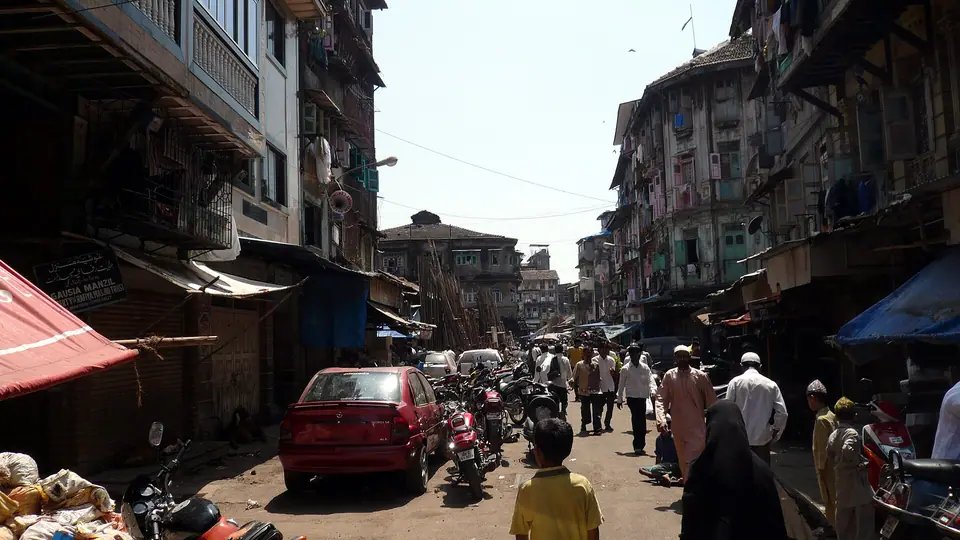
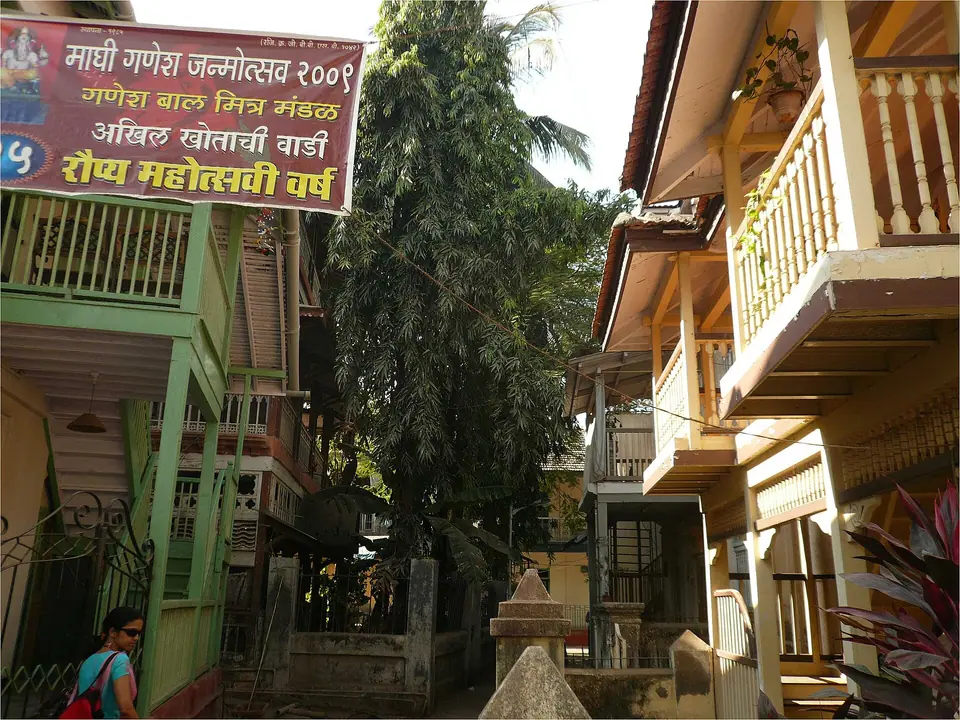
Outside, the streets are given over to trade. Bhuleshwar is a market district, with shops of cloth, kitchenware, flowers and festival supplies packed along lanes barely wide enough for the handcarts moving through them. Walking here is slow, and that is the point: this is the old city going about its business. A short walk in any direction brings more small shrines, old buildings with wooden balconies and the constant traffic of a wholesale quarter.
- The lane of flower and offering stalls that leads up to the temple entrance.
- The sanctum, where the image of the goddess is dressed in flowers and lit by lamps.
- The bell at the entrance, rung by devotees before they go in.
- The lanes of Bhuleshwar, given over to cloth, kitchenware, flowers and festival supplies.
Getting to the temple
Bhuleshwar lies in the island city, where autorickshaws do not operate, so the last part of any journey is by black-and-yellow taxi, app cab or on foot. CSMT is about 0.8 km away in a straight line, and the walk north through the Crawford Market area is straightforward. Churchgate and Marine Drive are about 1.4 km away on the other side, through the Fort's streets and the markets of Kalbadevi.
Marine Lines on the Western line and CSMT on the Central line are the nearest railheads, and the Harbour line shares CSMT. City buses run along Bhuleshwar's main roads. Metro Line 3, the underground Aqua Line, has stations in the Fort and Churchgate area, which shortens the walk from the south; new lines and stations keep opening, so check the current network before setting out. Traffic in the lanes is heavy through the working day.
When to go
Early morning is the calmest part of the day. The bazaars have not filled yet, the lane outside is walkable, and the queue at the shrine is short. Weekday mornings are easier than weekends. Navratri, in September or October, is the temple's busiest period, since Mumba Devi is one of the city's principal goddess shrines; the same is true of the days around Gudi Padwa, when processions leave from Girgaon and Dadar, both a short ride away.
Allow a short stop for the shrine and rather longer for the streets around it: the bazaars are the larger part of the visit. The dry months from November to February are the most comfortable for walking this quarter, with warm days and cooler evenings. March to May is hot and humid, and October is humid too. The south-west monsoon arrives around early to mid June and lasts to about late September; roads here are low-lying and flood, and dates vary each year.
Nearby sights on foot
Crawford Market, completed in 1869 and now officially the Mahatma Jyotiba Phule Mandai, is the obvious next stop, with bas-reliefs by John Lockwood Kipling on its facade. CSMT, designed by F. W. Stevens and built between 1878 and 1888, is a UNESCO World Heritage Site and the grandest of the city's stations. Between the two, the old city's wholesale streets run north towards Bhuleshwar, so the whole group can be walked in one outing.
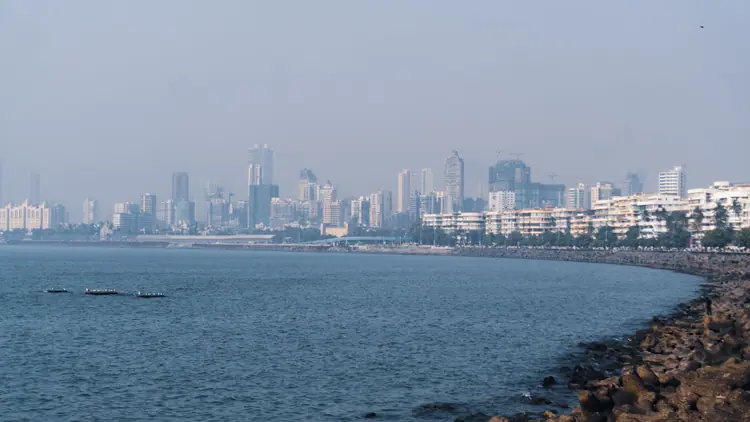
South of Bhuleshwar, the Fort holds Flora Fountain, erected in 1864 at what is now Hutatma Chowk, Horniman Circle with the Asiatic Society Town Hall of 1833, and the Kala Ghoda museums. Chor Bazaar, around Mutton Street beyond Mohammed Ali Road, sells old goods, brass and film posters, though most shops close on Fridays, so check before you go. Marine Drive and the Art Deco seafront, part of the 2018 World Heritage listing, are about 1.4 km south.
- Crawford Market, completed in 1869, with bas-reliefs by John Lockwood Kipling on its facade.
- CSMT, the Victorian Gothic terminus built between 1878 and 1888, now a World Heritage Site.
- Flora Fountain at Hutatma Chowk, erected in 1864, and the Asiatic Society Town Hall at Horniman Circle.
- Chor Bazaar, around Mutton Street, for old goods and film posters; most shops close on Fridays.
Practical tips for visitors
Mumba Devi Temple is a place of worship, so dress with that in mind: shoulders and knees covered, a scarf useful for women, and loose cotton that suits the heat. Footwear comes off before the inner shrine, so sandals are easier than laced shoes. Photography rules can change, and pictures around the sanctum may be restricted, so ask the staff or watch for notices. Phones stay on silent.
The lanes of Bhuleshwar are narrow and crowded, and handcarts add to the crush. Keep bags closed and in front of you, hold children's hands, and step into a shopfront to let a crowd pass rather than pushing. If the queue at the sanctum is dense, wait at the side. In the monsoon the streets here flood, so waterproof footwear and a change of clothes help, and the crowds thin on very wet days.
Editorial review: 16 November 2026 · imptmumbai.in, written with AI assistance (see the editorial policy).