- Area
- Girgaon, South Mumbai
- Character
- Wooden houses with verandas
- Settled by
- East Indian families, 19th century
- Nearest station
- Grant Road, Western line
A lane of wooden houses
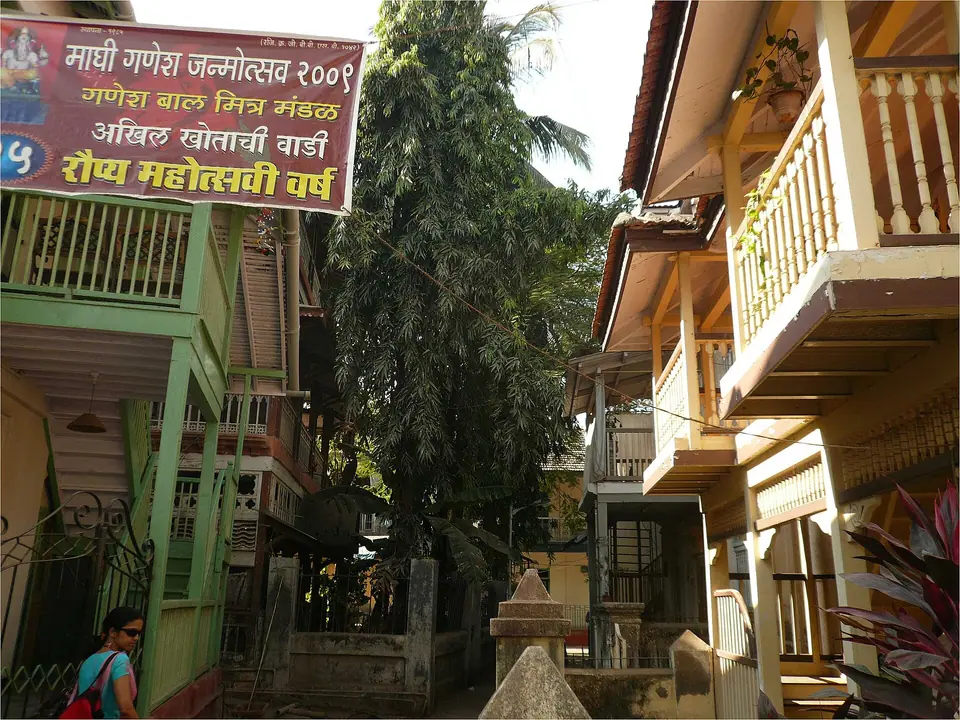
Khotachiwadi is a lane of old houses in Girgaon, in the southern half of the island city. What makes it unusual is the form of the buildings: two-storey wooden houses with verandas, sloping tiled roofs, small front steps and courtyards, painted in strong colours. Around them, Girgaon has become a dense grid of mid-rise buildings, so the lane reads as a survival rather than a set piece. People live in these houses today, and the wadi is a residential street first and a sight second.
The name is usually traced to Khot, a Parsi landlord associated with the land, and wadi, a Marathi word for a lane or a small hamlet. The lane sits a short turn off a busy Girgaon road, close to Grant Road station, and is easy to pass without noticing. The entrance is narrow; the houses begin a few steps in. Walk it once to get the shape of the place, then again more slowly to look at the woodwork and the colours.
East Indian roots
Khotachiwadi was settled in the nineteenth century by East Indian families, the Marathi-speaking Catholic community whose villages once covered much of the islands and whose older settlements lie to the north and in Bandra. The houses follow a coastal pattern: a veranda or a raised front platform to shade the rooms behind, high ceilings, timber upper floors, and a small plot in front. East Indian kitchens kept their own repertoire, including bottle masala made once a year, fugias at Christmas and sorpotel for feast days.
Much has changed around the houses. Through the twentieth century Girgaon filled with new buildings, and families who moved to the suburbs often sold the family house. The houses that survive do so partly because owners kept repairing them and partly because residents argued for the lane's protection over many years. This is not a museum village. Some houses are freshly painted, some are worn, and all of them are homes rather than exhibits. Walk quietly and treat closed doors as closed.
What to see in Khotachiwadi
Start with the shape of the houses rather than the details. Most are two storeys, with a tiled roof, a projecting balcony or gallery on the upper floor and a shaded ground floor behind a veranda or platform. Timber posts, carved brackets and sloping eaves do the structural work, and the paint schemes are strong: ochre, green, blue, pink. Because the lane is narrow, the houses are easier to see by standing back a few steps and looking up.
Then look at the details. House names are painted on the fronts, some in English and some in Marathi. Doorways keep old grilles, fanlights and carved frames, and many steps carry a coat of red oxide or whitewash. Plants spill from window ledges, cats sleep on the platforms and washing hangs above the lane. Small shrines and crosses appear where families have placed them. None of this is staged, so the detail changes from month to month and from house to house.
- Look up at the timber balconies and the brackets that carry the roof overhangs.
- Notice the raised front platforms, which take the place of a full veranda.
- Read the painted house names, some in Marathi and some in English.
- Check the old tile work and the painted steps at each entrance.
Getting to Khotachiwadi
Grant Road on the Western line is the closest station, and the lane is a short walk from it. Charni Road, one stop south, is another option for anyone coming from Churchgate or Marine Lines. Black-and-yellow taxis and app cabs can drop you on the main road; auto-rickshaws do not operate in the island city south of Bandra and Sion, so they are not an option here. Metro Line 3 runs through this part of the city; check the current station list before setting out.
Coming on foot is the simplest approach. From Grant Road station the walk crosses a busy road or two, past shops and offices, and the turn into the lane comes up quickly; ask for Khotachiwadi if the entrance is missed. Traffic in Girgaon is heavy through most of the day, so allow more time than the map suggests. Once inside, the lane is short and quiet, and there is no set route: walk to the far end, turn, and come back.
When to go and how long
The dry months from November to February are the easiest: warm days, cooler evenings and little rain. March to May is hot and humid, so plan the walk for the morning or late afternoon. The south-west monsoon arrives around early to mid June and runs to about late September, with heavy rain and flooded low roads; dates vary each year, so check before you go. October stays hot and humid after the rains clear.
Festival days change the lane's mood. Gudi Padwa, the Marathi New Year in March or April, brings gudis at windows and morning processions through Girgaon, Dadar and Thane; dates move with the Hindu calendar, so check before you go. Christmas is marked by East Indian families, and Ganesh Chaturthi in August or September fills Girgaon Chowpatty with immersions. For the lane alone, half an hour is enough; with Girgaon and the seafront, allow half a day.
Nearby sights, tips and stays
Dress for a city street rather than a monument: light cotton, shoulders covered if you plan to visit temples nearby such as Mumba Devi in Bhuleshwar, and shoes that cope with uneven stone, kerbs and puddles after rain. The lane is home to residents, so keep voices low, do not open gates or peer into windows, and step aside for people on scooters or on foot. Crowds are usually small; festival days and Sunday afternoons bring more visitors.
Nearby, Girgaon Chowpatty and the seafront at Marine Drive are a walk away, and the Mumba Devi temple in Bhuleshwar sits just inland among the old market lanes. Grant Road and Charni Road have Irani café stops and street food around them, useful before or after the walk. Further out, the Dr Bhau Daji Lad Museum in Byculla and the Victorian buildings around CSMT are a short taxi ride east and south.
For a short stay, the streets around Grant Road and Mumbai Central put the lane within walking distance, with a mix of guest houses and small hotels in the grid behind the stations. Tardeo, about 1.7 km away, is another option and still close. Further south, the Marine Lines and Churchgate areas suit anyone who wants the seafront and the museums as a base. Book ahead in the dry months and around Ganesh Chaturthi, when the city fills up.
- Carry water and a hat in the hot months, and an umbrella in the monsoon.
- Ask before photographing people, doorways or the inside of a house.
- Keep to the lane and the open passages; the side staircases lead to private homes.
- Combine the walk with a stop at Girgaon Chowpatty or the Mumba Devi temple.
Editorial review: 16 November 2026 · imptmumbai.in, written with AI assistance (see the editorial policy).