- Ferry
- ≈ 1 h each way
- Closed
- Mondays
- Time needed
- Half a day
- Leaves from
- Gateway of India
The Elephanta Caves are a group of rock-cut cave temples on Gharapuri island in Mumbai harbour, dating mostly from the fifth to sixth centuries. They were inscribed as a UNESCO World Heritage Site in 1987. The Portuguese named the island after a large stone elephant found near the landing — the statue now stands in the city museum garden at Byculla.
What you will see
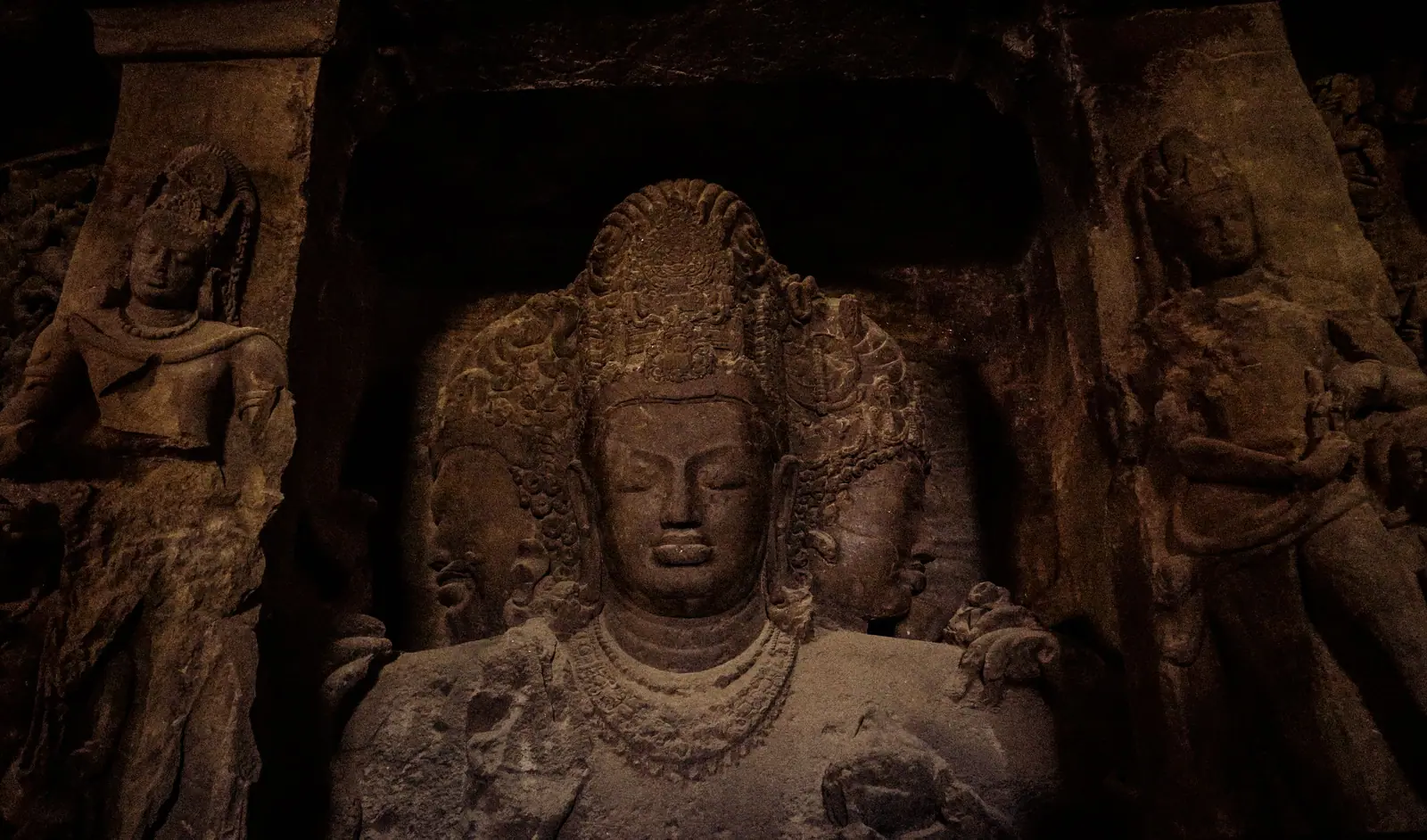
The main attraction is Cave 1, the Great Cave, a pillared hall cut deep into the hillside. Its most famous sculpture is the Trimurti — a huge three-headed bust of Shiva, around six metres tall, showing him as creator, preserver and destroyer. Around the hall, carved panels show Shiva as Lord of Dance, the marriage of Shiva and Parvati and Ardhanarishvara, half male and half female.
How to get there
- Ferries leave from the jetty beside the Gateway of India, usually from around 9 am, with the last return in the late afternoon.
- The crossing takes about an hour. From the island jetty a small toy train or a short walk leads to the steps.
- Around 120 steps climb to the caves, lined with stalls. Palanquins are available for those who cannot manage the climb.
- Buy cave tickets at the counter on the island; foreign visitors pay a higher fee than Indian citizens.
Practical advice
The caves are closed on Mondays. Ferries may be suspended in rough weather during the monsoon (roughly June to September), so check before you go. Carry water, wear shoes you can walk in, and keep food out of sight of the island’s monkeys. Allow four to five hours for the round trip.
Reading the panels in the Great Cave
The Great Cave works as a temple rather than a gallery. A pillared hall leads to a shrine holding the linga, and the walls around it carry large panels of Shiva in different forms: Gangadhara receiving the river Ganga in his hair, Ardhanarishvara as half man and half woman, Nataraja in dance, and the fierce form that destroys the demon Andhaka. Read them in the order you meet them, because each answers the one before. Light inside falls unevenly, so give your eyes a few minutes after the glare outside.
The three-faced bust known as the Trimurti or Sadashiva stands about six metres high in the wall of the north entrance. Its faces are read as the creator, the preserver and the destroyer. Guides work the site and explain the panels at a pace that suits a group, and a quiet solo walk shows more of the carving. Parts of the sculpture are damaged, and the breaks make the surviving detail easier to see. Go early, before the tour groups fill the hall.
The island around the caves
Gharapuri is a lived-in island, not a monument park. From the jetty, lanes of low houses and fishing boats run along the shore, and the path up to the caves passes stalls selling drinks and snacks. Few visitors go further, but the smaller group of caves on the eastern hill is quieter and partly overgrown, and the walk between the two groups gives views back across the harbour towards Mumbai. Allow time for it rather than treating the island as a queue for the boat home.
There is little shade on the walk and the rock holds heat, so carry water and start early in the day. Monkeys live around the caves and will take food from an open bag; keep snacks closed and out of reach. There is no safe swimming from the island shore. The site is a protected monument, so stay on the paths, keep off the carved surfaces, and carry rubbish back to the city with you.
Editorial review: 16 November 2026 · imptmumbai.in, written with AI assistance (see the editorial policy).